Custom AI apps on Langdock
Software That Fits Your Work, Without Owning All of It Link to this headline
We build custom AI apps on the platform your company already trusts, around the work that eats your team’s week. Your people get hours back and the quality stays.
We build on
- Langdock
- Mistral
- GDPR compliant
- ISO 27001 certified
- SOC 2 Type II audited
- EU hosted
There Used to Be Nothing Between Buying and Building Link to this headline
Buy software that almost fits, or pay for software that fits and then carry it. AI platforms have opened a third option that keeps the good half of each.
Buy
Ready-made
PowerPoint, Office, standard tools
- Available tomorrow
- Someone else keeps it running
- Never quite fits your process
- Your people fill the gaps by hand, every day
Build
Fully custom
Software written only for you
- Fits your process exactly
- Changes when your work changes
- Expensive and slow to build
- Yours to fix and keep alive, for good
New
Built on your AI platform
A custom app on a shared, maintained base
What you keep from buying
- Someone else keeps it running
- Security is signed off once, for the platform
What you keep from building
- Fits your process
- Changes when your work changes
What it still takes: time with your people to get the workflow right.
We Build on Langdock Link to this headline
Langdock is the compliant foundation. Your app is the tip of the iceberg. In between sits a base we maintain for all our clients. Select a layer to see what it does.
We build on
- Langdock
- Mistral
- GDPR compliant
- ISO 27001 certified
- SOC 2 Type II audited
- EU hosted
An example
Why We Built Dinghy Decks Link to this headline
A consultancy’s product is its decks. Its people had bolted three add-ons onto PowerPoint to get faster, and ended up with four things that don’t work together.
Before
- Four tools to license, update and train people on
- AI-made slides can’t use the slide library or the charts
- Every deck ends with hours of formatting back into the brand
After
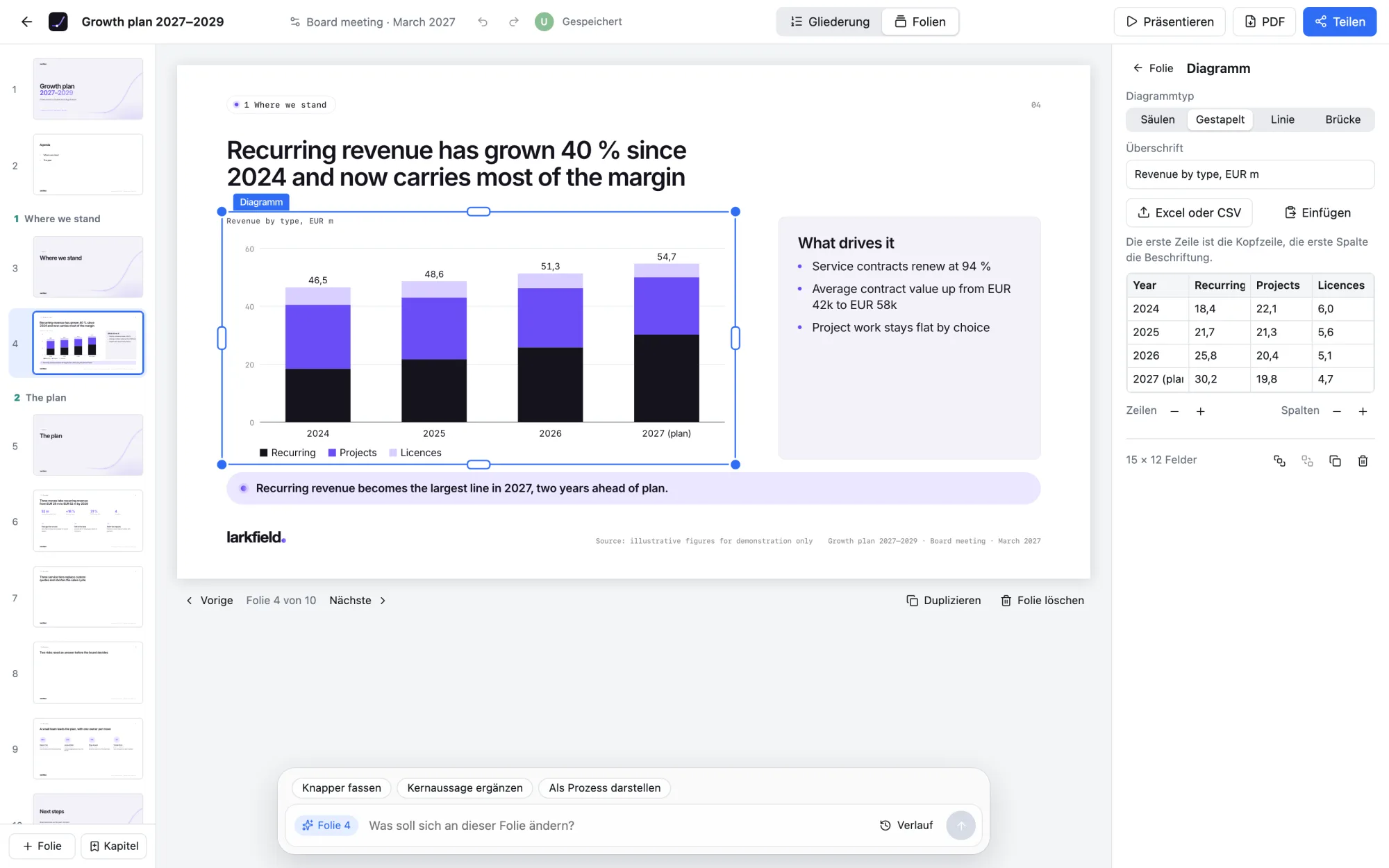
- One tool, set up in your corporate design
- The assistant drafts with your building blocks and your charts
- One thing to maintain, and we maintain it
In beta with a restructuring consultancy
Recorded in the real tool with a demo brand and invented figures, sped up two to eight times. The interface is in German.
Straight Answers Link to this headline
Who owns what?
Your data, your content, and anything we build only for you are yours. Products like our deck tool stay ours, and you use them.
Who maintains it?
We do. Our products and the shared base underneath are kept current across all our clients, so an update for one is an update for everyone.
What do we pay for?
Our time with your people, finding the gaps and designing the solution, on a retainer. The build itself is faster because it sits on that base.
How do we get out again?
Your data and everything you have produced can be exported at any time.
Do we need Langdock?
No. We build on enterprise AI platforms like Langdock, or in your own infrastructure. If you already have a platform, we start there.
We Understand Your Business First, Then Build Link to this headline
Most of our time goes into working with your people, not into code.
- 1
With your people
We sit with the staff who do the work and find where the hours go.
- 2
Pilot
One workflow, built on the base, tested on real documents.
- 3
Rollout
Your champions take it into their teams. We stay close.
- 4
Your team builds too
On the same base and within the same security rules, your staff extend what works.
Bring one document your team dreads Link to this headline
We’ll show you what it could look like on this stack.